FDA warning letters and supplement ingredient testing: our count, 2021 to 2026
Published by CleanIngredients, publish date pending. Data pulled 15 November 2026 from FDA's public warning letters table. Not legal or regulatory advice.
Of 58 FDA warning letters citing 21 CFR Part 111 from January 2021 to November 2026, 41 cited section 111.75. 41 of 58 (70.7%) cite 21 CFR 111.75. We read the full text of every non-tobacco FDA warning letter in FDA's public table, 2,595 letters issued from January 2021 to 3 November 2026. Of the 58 that cite the dietary supplement CGMP rule (21 CFR Part 111), 41 cite section 111.75, the rule on determining whether ingredient and product specifications are met. Method, data, and limits are below.
Key numbers
- 58 warning letters cite 21 CFR Part 111 (4 Jan 2021 to 3 Nov 2026).
- 41 of 58 (70.7%) cite 21 CFR 111.75.
- 13 of 58 (22.4%) cite 111.75(a)(1), the identity test for dietary ingredients.
- 13 of 58 (22.4%) cite 111.75(a)(2). The union of (a)(1) or (a)(2) is 16 letters (27.6%), and those sets overlap so they are not added together.
- 6 of 58 (10.3%) cite 111.75(a)(2)(ii), the conditions for relying on a supplier's certificate of analysis. By year: 2022 1, 2023 2, 2024 1, 2025 0, 2026 2.
- Chart and table by year below. Download the CSV.
Why we counted this
CleanIngredients is a free public-evidence directory for US supplement brands comparing plant-extract manufacturers in China. Our scores describe how much public documentation a supplier has shown, not product safety, and we do not independently test suppliers. FDA's rules for US finished-supplement makers are one reason brands ask suppliers for documentation such as a certificate of analysis (COA). This page counts what FDA has said publicly, so buyers can see how often the testing and supplier-COA rules come up. It says nothing about any supplier we list or might list.
What 21 CFR 111.75 covers, in FDA's words
FDA's letters explain the rule in their own words. Two quotes, each from a public FDA letter. The rule text is 21 CFR 111.75 on eCFR.
21 CFR 111.75(a)(2) does not allow firms to rely on a certificate of analysis to confirm the identity of a dietary ingredient. Rather, under 21 CFR 111.75(a)(1)(i), you must conduct at least one appropriate test or examination to verify the identity of any component that is a dietary ingredient, prior to using a component...
to rely on the supplier's certificate of analysis for components other than dietary ingredients you must meet the requirements of 21 CFR 111.75(a)(2)(ii).
[Editor check before publishing: re-open both pages and confirm each quote verbatim, including the ellipsis cut. Also link the eCFR text of 21 CFR 111.75, https://www.ecfr.gov/current/title-21/chapter-I/subchapter-B/part-111/subpart-E/section-111.75, after confirming it loads.]
The count, by year
2,595 non-tobacco letters scanned. Year is the letter issue date, not the date FDA posted the letter. 2026 is partial. 2021 is likely incomplete.
| Year of issue date | Non-tobacco letters scanned | Letters citing 21 CFR Part 111 | Of those, cite 21 CFR 111.75 | Cite 111.75(a)(1) | Cite 111.75(a)(2) | Cite 111.75(a)(2)(ii) | Cite 111.75 and mention a COA |
|---|---|---|---|---|---|---|---|
| 2021 | 393 | 1 | 1 | 0 | 0 | 0 | 0 |
| 2022 | 428 | 12 | 10 | 3 | 4 | 1 | 3 |
| 2023 | 382 | 16 | 12 | 6 | 6 | 2 | 5 |
| 2024 | 421 | 8 | 4 | 1 | 1 | 1 | 2 |
| 2025 | 504 | 9 | 6 | 0 | 0 | 0 | 1 |
| 2026 (to 3 Nov) | 467 | 12 | 8 | 3 | 2 | 2 | 3 |
| Total | 2,595 | 58 | 41 | 13 | 13 | 6 | 14 |
12 of 16 Part 111 letters in 2023 cited 111.75, against 4 of 8 in 2024. Small counts, not a trend. 16 of the 58 (27.6%) cite 111.75(a)(1) or (a)(2).
Source: CleanIngredients, "FDA warning letters and supplement ingredient testing" (https://cleaningredients.co/research/fda-warning-letters-supplement-ingredient-testing), based on FDA's public warning letters table, data pulled 15 November 2026.
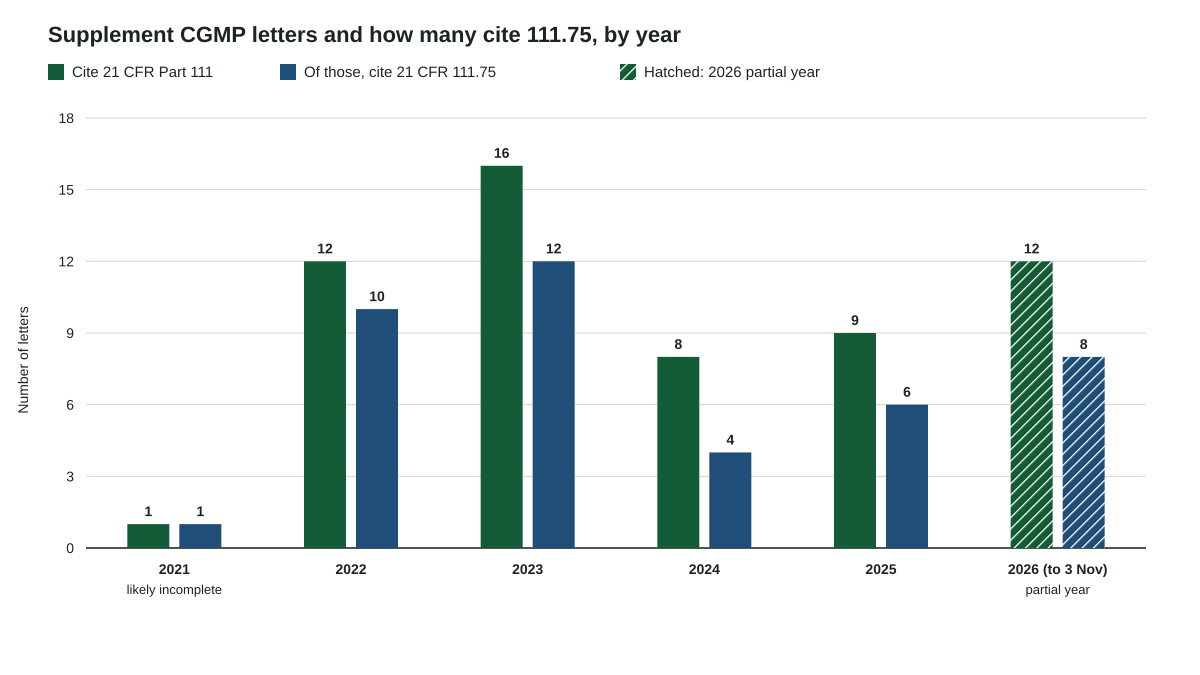
| Year | Cite 21 CFR Part 111 | Of those, cite 21 CFR 111.75 |
|---|---|---|
| 2021 (likely incomplete) | 1 | 1 |
| 2022 | 12 | 10 |
| 2023 | 16 | 12 |
| 2024 | 8 | 4 |
| 2025 | 9 | 6 |
| 2026 (to 3 Nov) (partial year) | 12 | 8 |
Source: CleanIngredients, "FDA warning letters and supplement ingredient testing" (https://cleaningredients.co/research/fda-warning-letters-supplement-ingredient-testing), based on FDA's public warning letters table, data pulled 15 November 2026.
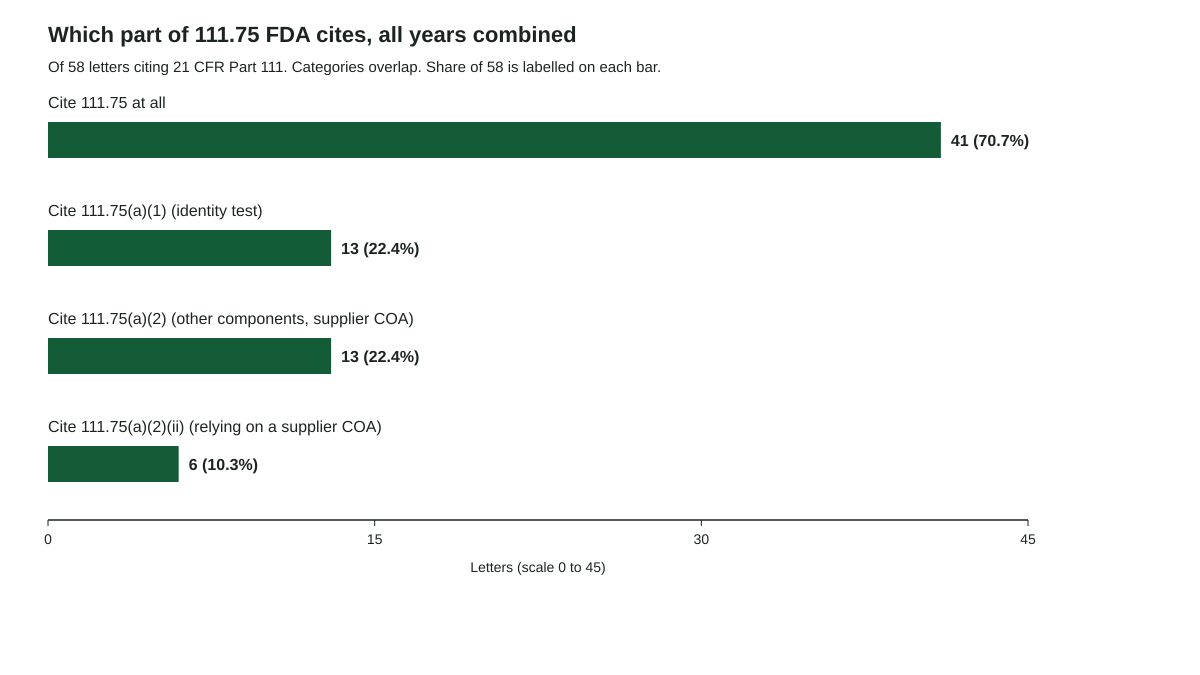
| Part of 111.75 | Letters | Share of 58 |
|---|---|---|
| Cite 111.75 at all | 41 | 70.7% |
| Cite 111.75(a)(1) (identity test) | 13 | 22.4% |
| Cite 111.75(a)(2) (other components, supplier COA) | 13 | 22.4% |
| Cite 111.75(a)(2)(ii) (relying on a supplier COA) | 6 | 10.3% |
What the numbers do and do not show
- They show how many published FDA warning letters, by FDA's own table, cite the testing and specification rule. 41 of 58 supplement CGMP letters cited it, so it comes up in most of them.
- They do not show how many firms are compliant, how many inspections happened, or anything about any one supplier or ingredient.
- Year-to-year changes are small counts. 2023 was the high year (12 of 16 Part 111 letters cited 111.75); 2024 had 4 of 8. We would not call that a trend.
- We did not filter by where an ingredient or firm is located. Nothing here is a statement about China-based or any other suppliers.
What this means for a brand reviewing a supplier's documents
- Ask what the COA covers and whether it is per lot. Our methodology gives weight to a per-lot COA available without an NDA (see /methodology).
- Treat a COA as one input. In the FDA letters quoted above, a COA alone does not satisfy the identity-test requirement for a dietary ingredient; the brand's own identity test is the requirement FDA names.
- If you rely on supplier COAs for other components, FDA's letters point to 111.75(a)(2)(ii), which is about establishing that the supplier's COA is reliable (FDA's wording in the quoted letter: "confirmation of the results of the suppliers' tests or examinations").
- Run a COA through our free checker: /tools/certificate-of-analysis. It checks completeness of the document. It does not confirm the lab result is true.
- Our supplier verification guide: /information/how-do-we-verify-ingredient-suppliers.
[Have a qualified person confirm items 2 and 3 against the rule text before publishing. They restate FDA's quoted words; do not extend them.]
Download and cite
- Download the 58 counted letters as CSV. Firm names are the names FDA lists in its public table.
- Download the yearly table as CSV.
- How to cite: CleanIngredients, "FDA warning letters and supplement ingredient testing: our count, 2021 to 2026," https://cleaningredients.co/research/fda-warning-letters-supplement-ingredient-testing, data pulled 15 November 2026 from FDA.
Method, step by step
- On 15 November 2026 we pulled FDA's warning letters table (3,807 rows, issue dates 4 Jan 2021 to 3 Nov 2026) from https://www.fda.gov/inspections-compliance-enforcement-and-criminal-investigations/compliance-actions-and-activities/warning-letters.
- We removed rows from the Center for Tobacco Products and downloaded the full text of each remaining letter: 2,595 unique letters.
- We marked a letter as a supplement CGMP letter if its text cites 21 CFR Part 111: 58 letters.
- Among those, we searched the text for "111.75", "111.75(a)(1)", "111.75(a)(2)", "111.75(a)(2)(ii)", and "certificate of analysis" or "COA", and grouped by the letter's issue date year.
- The CSV lists every counted letter with its FDA URL so anyone can check a row.
Limits: FDA's table only; text matching; small counts; 2021 may be incomplete; 2026 is partial. We did not count inspections, Form 483s, recalls, or import refusals.
Limits
- This counts letters listed in FDA's public table and whose text matched. It is not all FDA enforcement, not inspections, not Form 483s, not import refusals, not recalls. This is FDA's public table and text matching only.
- A letter citing a rule does not mean the firm was non-compliant on that point beyond what FDA's letter says, and counts say nothing about any supplier or about product safety.
- 2021 looks low (1 letter). We did not verify why. It may reflect how FDA's table or 2021 letter pages are populated, or fewer CGMP supplement letters that year. 2021 may be incomplete and is not a trend. Do not draw a trend from 2021.
- 2026 is partial (issue dates to 3 Nov 2026; latest Part 111 letter issued 19 Oct 2026).
- Small counts. Small year-to-year counts are not a trend.
- Letters were not filtered by country.
- Letters that cite Part 111 only by another route (for example mention "dietary supplement CGMP" without a citation) are not counted. Text matching can miss unusual formatting. We checked that no "111 . 75" style variants existed (41 letters either way).
- A few Part 111 letters are classed by FDA under other subjects (for example "Unapproved New Drugs/Misbranded"). The denominator is by text, not by FDA's subject label, on purpose. The 58 includes them.
- Numbers describe FDA's table as it stood on 15 November 2026. FDA can add, amend, or reissue letters.
FAQ
What is 21 CFR 111.75?
It is a section of FDA's current good manufacturing practice rule for dietary supplements (21 CFR Part 111). It deals with determining whether specifications for components and finished product are met, including identity testing of dietary ingredients and conditions for relying on a supplier's certificate of analysis. Read the rule text on eCFR.
Does a certificate of analysis satisfy FDA's identity test requirement?
In the FDA letter quoted above, FDA wrote that 111.75(a)(2) "does not allow firms to rely on a certificate of analysis to confirm the identity of a dietary ingredient." Read the letter and the rule, and ask your regulatory advisor about your case.
How many FDA warning letters cite 111.75?
In our count, 41 of 58 supplement CGMP letters issued from 4 January 2021 to 3 November 2026. See the table for years.
Does this page say anything about China-based suppliers?
No. We did not filter by country.
Does CleanIngredients test suppliers or ingredients?
No. We do not independently test suppliers. Our transparency scores describe public documentation, not product safety. No confirmed offering is listed yet.
Can I reuse the chart or data?
Yes, with attribution to CleanIngredients and a link to this page. The underlying records are FDA's public letters.
Sources
- FDA warning letters table: https://www.fda.gov/inspections-compliance-enforcement-and-criminal-investigations/compliance-actions-and-activities/warning-letters (pulled 15 Nov 2026)
- Each counted letter: URLs in the CSV
- 21 CFR 111.75 on eCFR: https://www.ecfr.gov/current/title-21/chapter-I/subchapter-B/part-111/subpart-E/section-111.75 [confirm link]
- FDA Data Dashboard, import refusals (not used; requires an API key): https://datadashboard.fda.gov/oii/cd/imprefusals.htm
- CleanIngredients methodology: https://cleaningredients.co/methodology
Data pulled and change log
Data pulled 15 November 2026.
- 15 November 2026: first count, from FDA's public warning letters table. Issue dates run from 4 January 2021 to 3 November 2026. This version does not refresh the data.
A later update should change the year table, the CSV, and the headline numbers together. Suggested cadence: once a quarter. No refresh is scheduled in this version.