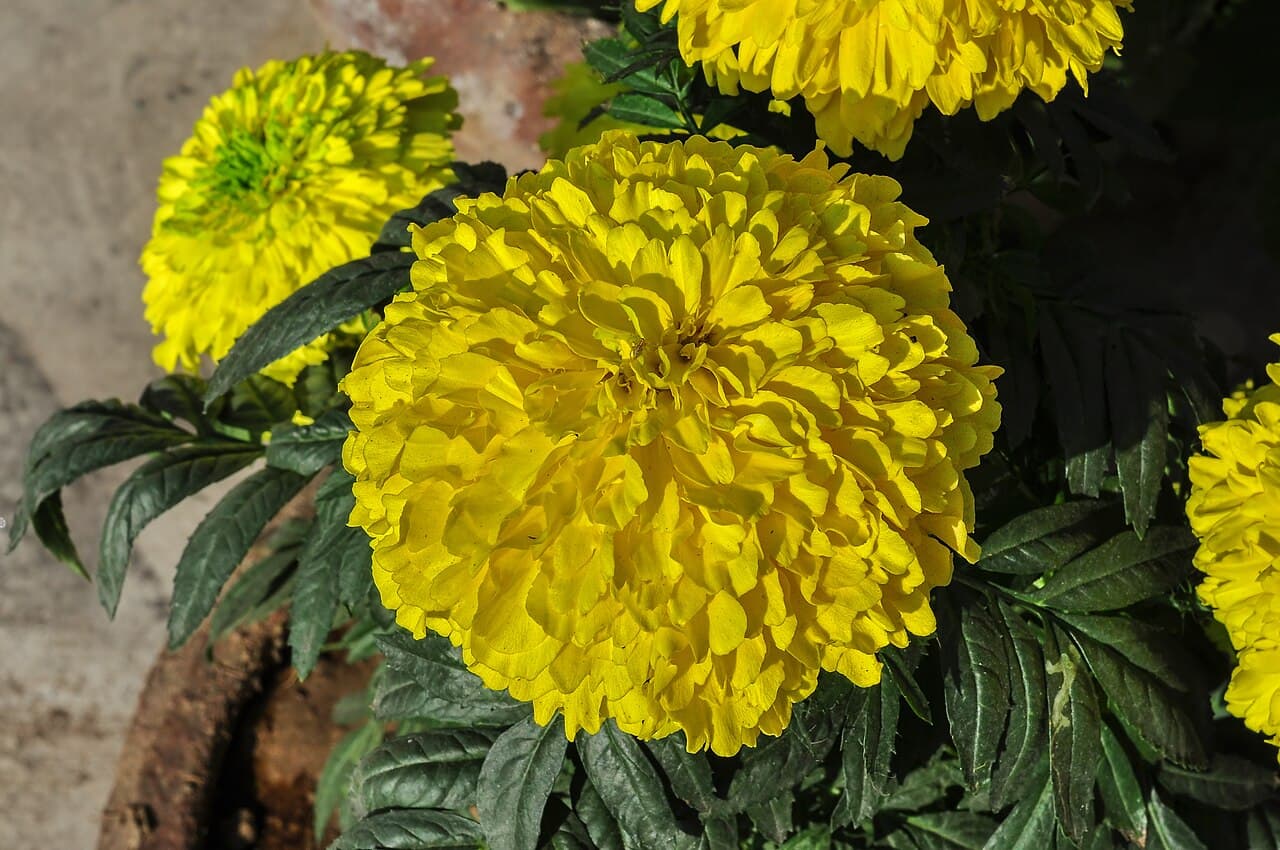
A marigold-flower carotenoid extract. Free lutein, esters, oils, and beadlets are different grades, and a factory address does not show where the flowers were grown.
Tagetes erecta flower. Lutein extracts on this page are described as coming from marigold petals. This photograph is not a manufacturing site. Photograph by Joydeep, CC BY-SA 3.0, via Wikimedia Commons.
Lutein is a xanthophyll carotenoid. Commercial dietary-ingredient extracts are commonly prepared from the petals of marigold, Tagetes erecta. Zeaxanthin is a different carotenoid. It may travel with lutein in a marigold extract, and it has its own page as a later research topic. It is not a substitute grade of lutein.
Free lutein, lutein esters, oil dilutions, starch beadlets, and water-dispersible powders are different articles. A percentage from HPLC is not interchangeable with a UV result, and an ester result is not interchangeable with free lutein. Some public process descriptions include fermentation or ensiling before extraction. A mixed route is outside the current plant-extraction scope.
China, India, and other countries all appear in public marigold-supply descriptions. A Chinese manufacturing address, or a Chinese registered office, does not establish that the flowers in a given grade were grown in China.
Public database references
Reference molecules describe chemical identity, not the composition, purity, origin, or safety of a supplier’s extract. These automated lookups do not change supplier rankings.
Search terms: lutein. 1 matching recall records in the available dataset, including historical and terminated recalls. Retrieved 2026-11-15. Source dataset updated 2026-11-04.
Matches can include finished foods and multi-ingredient products. They do not establish that this ingredient caused a recall or that any listed supplier was involved. No matches does not mean an ingredient or supplier is safe.
Tagetes erecta (marigold) is the usual species named for supplement lutein extracts. The species and the plant part should be on the specification for the grade being purchased.
Do not treat a lutein ester, a free-lutein crystal, and a beadlet made from that crystal as the same ingredient. Beadlets add wall materials and other carriers.
Plant part
Flower petals are the usual plant part for marigold lutein. A specification that omits the plant part is incomplete.
Common grades and distinctions
Free lutein versus lutein esters.
Oil, powder, crystal, beadlet, and water-dispersible forms.
HPLC versus UV assay, and the unit used for the stated percentage.
Feed-grade oleoresin versus a food or dietary-ingredient grade.
Listing status
No confirmed offering is listed. A confirmed row needs evidence of plant extraction, Chinese cultivation, Chinese manufacturing, and a manufacturing site tied to that grade.
Confirmed comparison
Confirmed offerings are plant-extracted, with reviewed evidence of Chinese cultivation, Chinese manufacturing, and an identified manufacturing site for that grade. Sorted by the exact transparency score, then by supplier and grade name.
No offering is in the confirmed ranking. A row is added only when the evidence covers that grade. An empty table is not a claim that no manufacturer exists.
Sample and quote requests stay closed until a confirmed offering is listed. You can still tell CleanIngredients what you need.
Ask which flower crop and harvest region supplied the lot, and for a document that is about that grade rather than the company’s whole agricultural footprint.
Separate the extraction plant from the registered office. A company can farm in one province and finish a crystal in another, or buy flowers from more than one country.
Read the process for fermentation, ensiling, or saponification. Saponification converts esters toward free lutein. Fermentation or ensiling is a different step and currently keeps the article out of the confirmed ranking.
For beadlets and cold-water-soluble powders, require the carrier and wall materials, not only the lutein percentage.
A single example COA does not show that every lot is tested. Prefer a lot-specific COA that can be obtained without an NDA.
Algae-derived carotenoids, synthetic lutein, and mixed fermentation-plus-extraction routes are out of scope.
No offering is ranked until Chinese cultivation, Chinese manufacturing, plant extraction, and the manufacturing site are each tied to that grade by reviewed evidence.
Compare the legal seller and actual plant, the exact grade and assay basis, botanical growing origin, manufacturing origin, and sample-lot documents separately. A company description is not confirmation of a grade or available stock.
Research lead · Not confirmed
Shaanxi Kingsci Biotechnology Co., Ltd.
Shaanxi, China (company identity; grade-specific plant address unconfirmed)
The supplier lists Tagetes erecta beadlets, HPLC testing and a sample option. These are supplier-published claims, not a confirmed directory offering or an independently checked stock position.
Still needed: The exact grade’s carrier composition, crop-origin records, named manufacturing/finishing sites, full production route and sample-lot COA. Sample costs, shipping and availability require direct confirmation.
Lutein Crystal is obtained from Marigold flower by fermentation, pelleting, extraction, saponification of crystallization and drying, tangerine colour and free state lutein, water-insoluble.
The company’s own English page describes fermentation as part of how lutein crystal is obtained, alongside extraction and saponification. That is a mixed route under the current scope, so the crystal is not listed as a plant-extraction offering. The same page states a health use related to macular degeneration. CleanIngredients does not adopt that statement. The page also lists powder, oil, beadlet, and crystal percentages without a lot-specific COA.
We plant 13,500 hectare marigold throughout China, India and Zambia.
The planting statement covers China, India, and Zambia together. It does not identify which country’s flowers are in any named lutein grade. Multi-country cultivation is not evidence of Chinese cultivation for a specific offering.
Published 2024-04-18. 第二节 公司简介和主要财务指标, 公司信息, 注册地址. Open the source
注册地址 河北省邯郸市曲周县城晨光路 1 号
Translation: Registered address: No. 1 Chenguang Road, Quzhou County, Handan, Hebei Province.English rendering of the Chinese annual-report table. The PDF splits the road name and the building number across table cells.
The registered address and the office address in this report are in Quzhou County, Hebei. That identifies a company address. It does not by itself identify the factory that finishes a named lutein grade, and it does not show where marigold flowers were grown. Quzhou has also been described by the company in connection with stevia planting, which is a different crop.
2023 annual report, management discussion of raw-material basesChenguang Biotech Group Co., Ltd. · checked 2026-11-14
Published 2024-04-18. 管理层讨论与分析, 2023 年原料基地建设. Open the source
Translation: Marigold raw-material planting area in Xinjiang and Yunnan was relatively stable, planted area in India continued to grow, trial marigold planting in Myanmar progressed, and the Zambia farm’s chili and marigold crops had another harvest.English rendering of the Chinese annual-report sentence. Abbreviated only by the surrounding sentence boundary.
The report supports marigold cultivation in more than one country, including Xinjiang and Yunnan, and also India, Myanmar, and Zambia. It still does not attach one lutein grade to one cultivation region and one manufacturing site. Food-grade lutein sales are discussed in the same report. Sales volume is not a transparency score.
Translation: Party A would invest 8 million yuan to build a factory, warehouse, and fermentation pools, and lease them after completion to the project company set up by Party B.English rendering of the Chinese note describing a 2019 cooperation agreement. This is a facility description, not a lot record.
The note links a Yutian County marigold project to fermentation pools as well as a factory building. Combined with the English product page, lutein processing at Chenguang is not documented as extraction alone. The same 2020 report says the company expanded marigold planting by more than 200,000 mu in Xinjiang and Yunnan. That is company-level cultivation evidence, not a grade-level offering, and it sits beside other countries’ supply.